


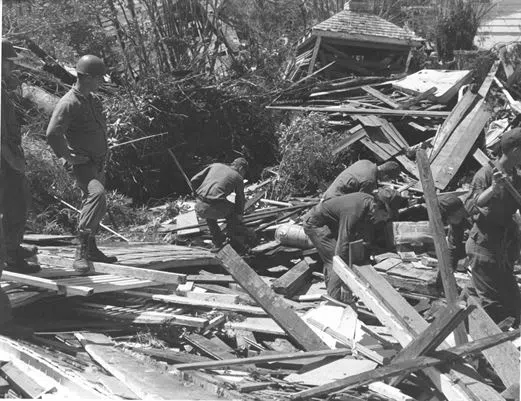
Saturday is the 50th anniversary of Hurricane Camille’s devastating landfall along the Mississippi coast in 1969.
Before Hurricane Katrina, Camille was the defining storm of a generation. State Climatologist Barry Keim says Camile certainly had Katrina beat in terms of hurricane-force winds when it made landfall. “When it hit Bay St. Lewis it had sustained winds of 175 miles per hour. For comparison purposes, Katrina made landfall with sustained winds of 127 miles per hour.”
Camile formed in the Caribbean just south of Cuba before making it’s way to the north-central Gulf Coast.
Keim says the impact was so devastating that it led to the creation of the Saffir-Simpson Scale, which categorized hurricanes in a way regular people could understand.
“A lot of people claim that they did not fully appreciate just how damaging Camille was going to be at landfall based on what they were being told.”
The system is one of only four Cat 5s to make landfall, those being the Labor Day Hurricane of 35’, Camile in 69’, Andrew in 92’, and Michael last year.
Camille had a limited impact on Louisiana outside of the far eastern coastlines due to its small size, but Keim says it was still a memorable event for those in its path.
“Camille produced a 24.6-foot storm surge in Pass Christian, Mississippi, and something that we don’t talk a lot about is that it also produced a 16-foot storm surge in Venice in Plaquemines, Louisiana.”
Camille is thought to be responsible for 259 deaths, and 9.7 billion dollars’ worth of damage adjusted for inflation. It cut a swath from the coast all the way up to Virginia where it dumped 31 inches of rain.