


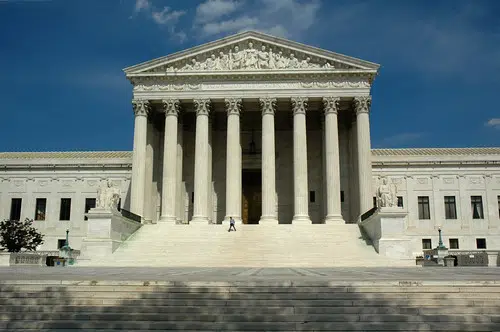
The US Supreme Court heard arguments this morning in Edwards vs. Vannoy, a case involving a Louisiana man that could result in retrials for all prisoners serving time on non-unanimous verdicts.
The case is a follow-up to a decision by the court last year, Ramos vs. Louisiana, that non-unanimous convictions were unconstitutional. Attorney Andre Belanger argued Ramos should be retroactive.
“Jury unanimity predates the founding and ranks amongst our most indispensable rights,” said Belanger who then quoted a line from the court’s previous opinion, “It significantly improves the accuracy and fairness because a verdict taken from 11 is no verdict at all.”
Belanger represents Thedrick Edwards who is serving a life sentence in Angola on multiple non-unanimous convictions related to a 2006 crime spree in Baton Rouge.
Louisiana Solicitor General Liz Murrill argued against giving Edwards and other non-unanimously convicted inmates retrials.
“A supermajority verdict does not render a trial fundamentally unfair, nor does it seriously undermine the factual accuracy of the verdict,” said Murrill.
Murrill said that in Edwards’ case his crimes are severe, had an eye witness, and included armed robbery, kidnapping, and rape. She also said Edwards ultimately confessed to committing the crimes.
An estimated 1,500 Louisiana inmates are behind bars right now due to non-unanimous convictions. Murrill said giving them all retrials would be a burden.
“Requiring new trials in long final criminal cases would be impossible in some and particularly unfair to the victims of these crimes,” said Murrill.
Belanger countered that argument, again pulling from the written opinion in Ramos vs. Louisiana.
“As members of this court said in Ramos, we should not perpetuate something that we all know to be wrong, just because we fear the consequences of being right,” said Belanger.
In 2018 Louisiana voters approved a constitutional amendment requiring unanimous verdicts. That law took effect in 2019 but was not retroactive.


Comments