


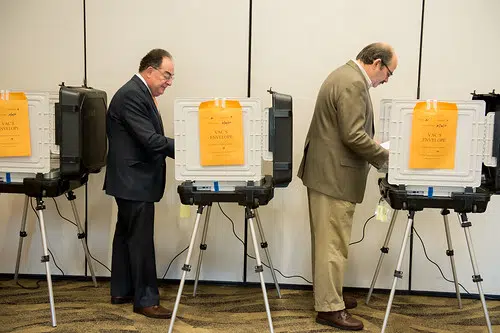
During the U.S. Senate primary election, there was a great deal of confusion in some polling places about the ballots that no-party voters could cast.
Some no-party reported being denied the ballot of their choice, when the rules clearly stipulated that they had that option.
That confusion could be compounded in the runoffs, for which early voting is now underway.
Trey Williams with the Secretary of State’s Office says for no-party voters who cast a Republican or Democratic ballot last month, barring a registration change in the interim (more on that later), there’s no last-minute party-switching allowed.
“If you voted as a no-party and even Republican or Democratic primaries back in May, then you will continue to vote in those closed primaries this go-around,” says Williams.
In other words, no-party voters who cast Republican ballots in the primary will cast Republican ballots in the runoff, and no-party voters who cast Democratic ballots in the primary will cast Democratic ballots in the runoff.
The no-party voters who still have the option are those who didn’t make a choice for U.S. Senate at all last month.
“If you chose not to vote back in May or chose not to participate in one of the closed party primaries or (are) newly registered to vote, then you will have the option to choose which closed party primary you would like to vote in,” Williams says.
There is one exception in which no-party voters — or any voter, for that matter — who cast ballots in one party’s primary can cast ballots in the other party’s runoff, but the deadline for them to act passed last Saturday.
“You can change your party choice at any time,” Williams notes. “If you did it before the deadline (June 6), you are able to vote in whichever party that you chose to vote in. So, if you voted in one closed party primary last election (then) changed your party to the other party, then you’re able to vote in that new party.”
Williams says it’s important to check your sample ballot on GeauxVote.com or the Geaux Vote mobile app.
“Your neighbor might have a ballot that is completely different than yours, just
depending on which precinct that you’re in,” Williams notes.
And if you’re a no-party voter, checking your sample ballot may save you from schlepping to the polling place for no reason.
“Depending on what perish you are in, if you are no-party and choose to vote no-party, then there actually might not be anything on your ballot,” Williams says.



Comments