


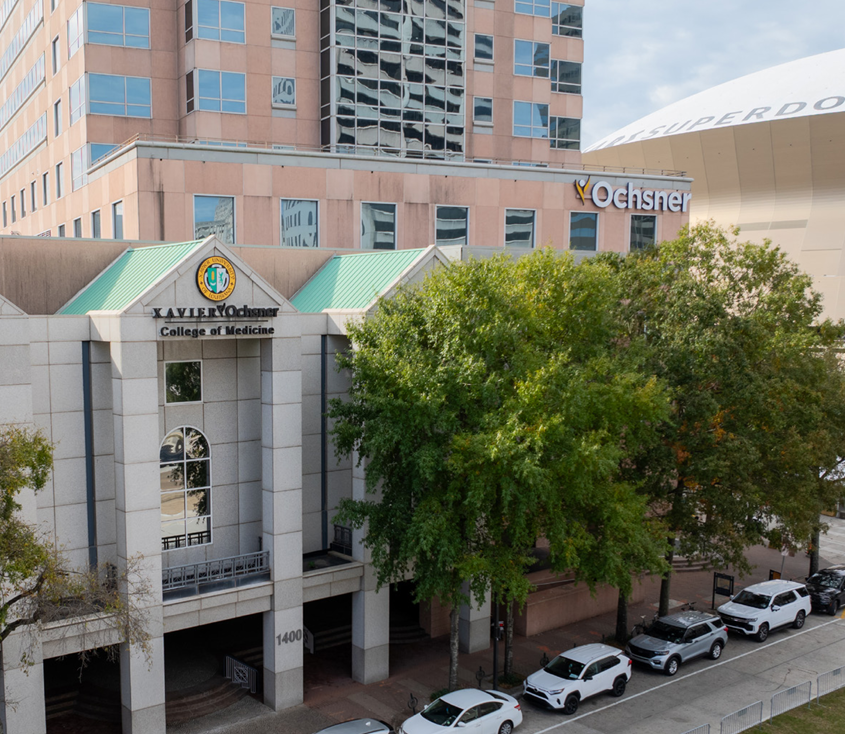
Credit: Xavier-Ochsner College of Medicine
The newest historically Black medical school has earned preliminary accreditation.
The Liaison Committee on Medical Education, which is the accrediting body for U.S. programs granting medical doctorate degrees, gave its preliminary accreditation to Xavier University’s Ochsner College of Medicine in New Orleans.
The school aims to address two shortages simultaneously.
“What we have is a shortage of physicians nationally, but also an extreme shortage of physicians of color,” says Dr. Reynold Verret, president of Xavier University.
Sixty of Louisiana’s 64 parishes are currently federally designated as Health Professional Shortage Areas.
Nationally, the National Health Resources and Services Administration projects that the U.S. could face a shortage of more than 140,000 physicians by 2038.
Verret says the school is the only HBCU college of medicine in the Gulf South and the first HBCU medical school to be on the path to full accreditation in a very long time.
“The last medical school formed at an HBCU was the Morehouse medical school, which was established in the 60s and 70s.”
Xavier’s college of medicine was formed through a partnership between the university and Ochsner Health in 2024 and earned candidate status in 2025.
The school’s location in New Orleans’ BioDistrict, making it easier for students to pursue real-world hands-on training.
Dr. Leonardo Seoane, the president and founding dean of the Xavier Ochsner College of Medicine, says it’s the culmination of a ten-year quest, and the school is gearing up to welcome its first class in the summer of 2027.
“Hopefully by next week’s students will apply to our medical school, we’ll start interviewing in November, says Seoane. “As early as December, we’ll be sending out acceptance letters to fill a class of 50 students that will start next summer.”
Dr. Seoane says while the initial class will be 50 students, he expects future classes to grow in size.
“We hope to go to 75 and then 100, and then we feel like 100 is a good number,” Seoane says. “So when we’re at full capacity, we’ll have 400 medical students, 100 per class.”




Comments